Operval at REAS 2026: Remote-Controlled Machines for Civil Protection, Fire Brigades and Emergency Response
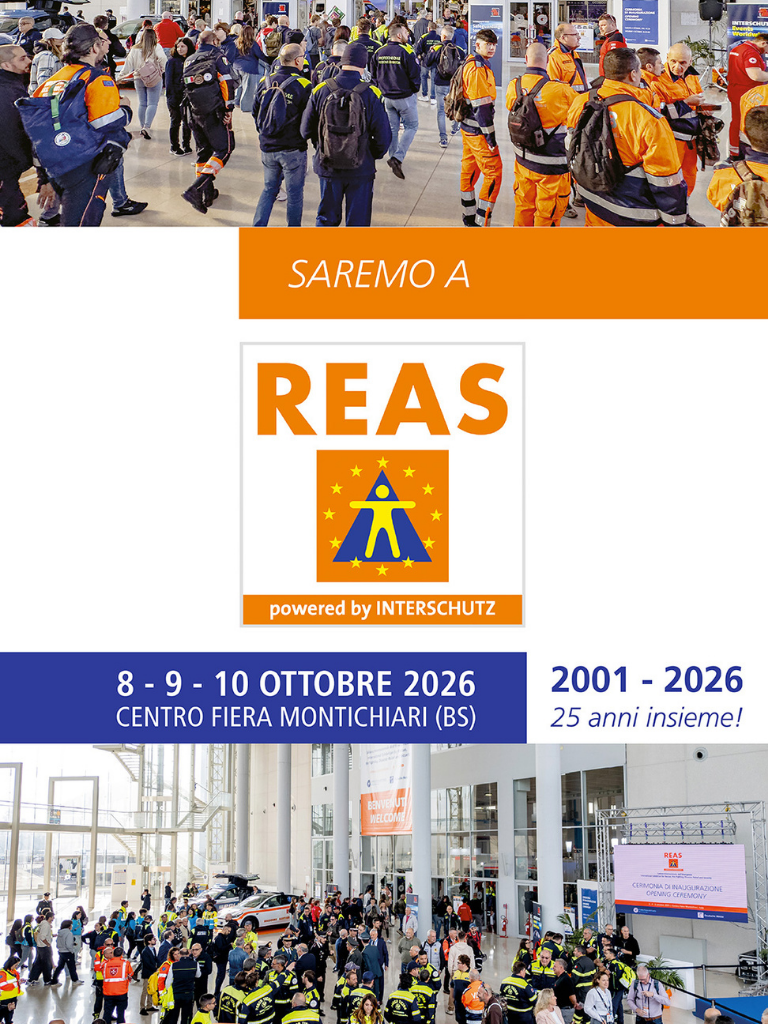
From 8 to 10 October 2026, Operval will be exhibiting at REAS – International Emergency Exhibition in Montichiari, Brescia, Hall 2 – Stand C11. An important opportunity to present Operval Safety and our remote-controlled solutions designed for Civil Protection organisations, Fire Brigades and emergency response operators.
There are situations in which simply reaching the intervention area is already part of the emergency.
A fire in a difficult-to-access location. A flood that makes roads and routes unusable. A landslide. Unstable ground. The need to transport pumps, generators, equipment or materials quickly to places where conventional vehicles struggle to operate.
In these scenarios, the ability to move machines and equipment can be crucial. But there is another factor we consider even more important: reducing operators’ exposure to risk whenever possible.
This is the principle behind Operval Safety, the Operval division dedicated to developing machines and solutions for emergency response and operational safety.
And this approach will be at the heart of our participation in REAS 2026 – International Emergency Exhibition, taking place from 8 to 10 October 2026 at the Montichiari Exhibition Centre, near Brescia, Italy.
You will find us in Hall 2 – Stand C11.
REAS 2026: A Key Meeting Point for the Emergency Response Sector
REAS is one of Italy’s leading exhibitions dedicated to emergency response, firefighting, Civil Protection, first aid and safety.
The 2026 edition is particularly significant, as the International Emergency Exhibition celebrates its 25th edition.
Over the years, REAS has become an important meeting point for companies, professional operators, volunteers, public authorities, associations, institutions and emergency services involved in prevention, rescue and crisis management.
For Operval, taking part in REAS means meeting directly with the professionals who use vehicles and equipment in the field and discussing their real operational needs.
And this is exactly the type of dialogue we are looking for.
We do not simply want to present machines.
We want to understand how our experience in mechanical engineering and remote-controlled technology can be applied to new emergency response scenarios.
Operval Safety: Mechanical Engineering for Operational Safety
Operval is built on decades of experience in mechanical engineering.
Our history began in 1947 and has developed through generations of technical expertise in maintenance, manufacturing and machine design.
Over the years, this experience has led us to specialise in the development of remote-controlled tracked machines, designed to operate on difficult terrain, slopes and in environments where accessibility and safety are key factors.
Today, we have decided to bring this experience even more decisively into the emergency response sector.
This is how Operval Safety was created.
A division that starts from one apparently simple question:
How can we use mechanical engineering and remote control to help operators work in the most critical environments?
The answer does not necessarily mean developing a different machine for every emergency.
Our approach is to design versatile and modular mechanical platforms capable of carrying and operating different equipment depending on the mission.
A single tracked base can therefore become a working platform for material transport, firefighting, pump and dewatering operations, area lighting or other applications developed according to operators’ needs.
Remote-Controlled Machines for Civil Protection and Fire Brigades
Civil Protection organisations, Fire Brigades and emergency response units often operate in environments that differ significantly from one another.
There is no single type of emergency scenario.
A machine may be required to operate on mud, gravel, uneven ground, steep slopes, flooded areas or locations where conventional vehicles have limited access.
For this reason, we believe the use of remote-controlled tracked machines for Civil Protection and Fire Brigades can offer significant operational advantages.
Tracks make it possible to operate on challenging surfaces and difficult terrain, while remote control changes the traditional relationship between operator and machine.
The operator does not necessarily need to be on board.
This concept, which we have been applying for years in the development of our machines, becomes even more valuable when applied to emergency response.
Because in certain situations, the challenge is not simply getting a machine to a specific location.
The real challenge is doing so while reducing, as far as possible, the operator’s exposure to the highest-risk area.
Operator Safety During Emergency Response Operations
When discussing safety in emergency response, oversimplification must be avoided.
No machine can eliminate every risk involved in an emergency operation.
Technology can, however, change the way certain tasks are performed.
This is the principle behind our remote-controlled solutions.
If a specific operation can be carried out by a machine while the operator controls it from a more protected position, it becomes possible to act on one of the key elements of risk management: human exposure to hazardous conditions.
This principle can be applied to many different situations:
- firefighting operations;
- wildfires and forest fires;
- floods and water emergencies;
- landslides and ground instability;
- unstable terrain;
- difficult-to-access areas;
- emergency equipment transport;
- pump and dewatering equipment handling;
- operational area lighting;
- emergency logistics;
- support for Civil Protection and Fire Brigade operations.
The aim is not to replace the operator.
Quite the opposite.
The objective is to use technology to support operators during the most demanding or potentially hazardous tasks.
One Tracked Platform, Multiple Configurations
One of the key concepts we will present at REAS 2026 is modularity.
Emergencies are, by definition, difficult to standardise.
For this reason, we believe it is strategically important to design machines that can adapt to different applications.
Operval tracked platforms can be equipped with different modules and accessories, allowing the machine to be configured according to specific operational requirements.
The concept is simple:
One platform. Multiple solutions.
A machine can be used as a load platform for transporting materials and can later be configured, for example, with a firefighting module, lighting tower or pump-handling system.
This modularity makes it possible to think beyond the individual machine and consider the efficiency of the entire vehicle and equipment fleet.
For a Civil Protection organisation, emergency service or public authority, this means evaluating a platform that can potentially be used in several different situations throughout the year.
Machines and Equipment for Flood Response
Floods are one of the emergency scenarios on which we are currently focusing a significant part of our research and development activities.
During hydrogeological emergencies, one of the main challenges is reaching the area where intervention is needed quickly.
Mud, debris, water and damaged infrastructure can make equipment transport extremely difficult.
Among the essential tools for flood response are, of course, dewatering pumps and water pumping systems.
However, having a high-performance pump does not automatically solve the operational problem.
It must be transported.
Positioned.
Made operational.
And moved again when conditions change.
This is precisely where we have decided to focus our development work.
At REAS 2026 We Will Present a New Approach to Dewatering Pump Mobility
At REAS, we will present a project that Operval is developing as part of its research and development activities.
A new approach to flood response: a machine designed to optimise the transport and use of a dewatering pump directly in the field.
The project starts from the observation of real operational challenges.
High pumping capacity is essential, but during emergencies, the speed with which equipment can reach the required location and become operational is equally important.
This has led us to develop the concept of integrating a pumping system into a mobile tracked solution.
The project therefore aims to combine two key requirements:
mobility on difficult terrain and water management.
A solution designed in particular for Civil Protection operations and for all organisations required to respond to floods, water emergencies and hydrogeological events.
REAS will also be an important opportunity for us to collect feedback, operational requirements and suggestions directly from professionals in the field.
Because a solution designed for emergency response must be developed through dialogue with the people who actually manage emergencies.
Remote-Controlled Machines for Firefighting Operations
Another area in which remote-controlled platforms can offer interesting applications is firefighting.
Fires, and wildfires in particular, often develop in areas characterised by slopes, vegetation, narrow routes or uneven ground.
In these situations, it may be necessary to transport water, hoses, pumps, equipment and materials to locations that cannot easily be reached by conventional vehicles.
A remote-controlled tracked platform equipped with a firefighting module can provide support for equipment transport and specific field operations.
Once again, the principle remains the same: using a compact, tracked, remote-controlled machine to access complex areas and support emergency teams.
The machine therefore becomes one element within the overall operational strategy.
It is not the centre of that strategy.
The operator remains at the centre.
Wildfire Response and Terrain Accessibility
Wildfires clearly demonstrate how important accessibility and mobility are during emergency operations.
The characteristics of the Italian territory make this issue particularly relevant.
Mountain, hilly and forested areas may include narrow roads, steep slopes and routes unsuitable for conventional vehicles.
In these environments, a compact tracked machine can be used to transport equipment and materials along routes where larger or wheeled vehicles may encounter greater difficulties.
Remote control provides an additional advantage: it allows the operator to choose the most suitable position from which to control the machine, depending on the environment and the specific task being performed.
It is a technology we know well and have been developing for many years.
We now want to expand its applications further within the firefighting and wildfire response sector.
Tracked Machines for Landslides, Ground Instability and Difficult Terrain
Another important application concerns emergency operations following landslides, ground movement and hydrogeological instability.
In these scenarios, the terrain itself can make movement extremely difficult.
A machine’s ability to operate on uneven surfaces therefore becomes a key factor.
Tracked platforms can be used to transport:
- equipment;
- materials;
- generators;
- pumps;
- lighting systems;
- tools;
- other equipment required by emergency teams.
The possibility of configuring the machine according to the mission also allows it to be adapted to different operational requirements.
This is exactly what we mean by modularity.
It does not mean simply adding accessories to increase the number of available configurations.
It means designing a platform capable of solving different operational problems.
Mobile Lighting Towers for Emergency Areas
Emergencies do not only happen during the day.
Night operations or prolonged interventions require lighting systems capable of reaching the operational area quickly.
One possible configuration of Operval platforms therefore includes a lighting tower.
The advantage of a tracked platform is the ability to transport the lighting system over terrain where towing or moving conventional equipment may be difficult.
This type of solution can be useful during floods, earthquakes, landslides, search and rescue operations or any situation in which an illuminated working area needs to be established quickly.
Transporting Generators and Civil Protection Equipment
Logistics is a fundamental part of every emergency operation.
Very often, the required equipment already exists.
The problem is getting it exactly where it is needed.
Generators, pumps, hoses, tools, materials, communication systems and other equipment must be transported even when normal road conditions have been compromised.
This is why one of the simplest configurations may also be one of the most useful: the load platform.
A surface on which equipment and materials can be carried, using the mobility of the tracked machine to cover the final distance between the logistics vehicle and the actual intervention area.
In practical terms, it can act as a link between conventional logistics and the precise location where equipment is needed.
Remote Control as an Operational Safety Tool
Remote control is often seen simply as an alternative way of operating a machine.
For us, it represents much more.
It is a technology that changes the relationship between operator, machine and environment.
On a conventional machine, the operator’s position is determined by the driving station.
On a remote-controlled machine, the operator can instead choose the most suitable position from which to manage the operation, always within the limits and procedures required for safe use.
This can provide a different view during certain manoeuvres and makes it possible to avoid having the operator physically on board the machine.
In emergency response applications, this concept becomes particularly important.
It does not mean making an intervention completely risk-free.
It means having one additional possibility for organising the operation more safely.
And this is exactly what we want to continue developing.
P08, P14 and P24: Operval’s Range of Remote-Controlled Tracked Dumpers
The technical experience behind Operval Safety also comes from the development of our range of remote-controlled tracked dumpers.
The range currently includes three main models: P08, P14 and P24, developed to meet different requirements in terms of payload and dimensions.
P08: Compact Size and Accessibility
The P08 is the most compact model in the Operval range.
With a load capacity of up to 800 kg, it has been designed to combine compact dimensions, manoeuvrability and off-road mobility.
Its small footprint can be particularly useful when working in confined spaces or along narrow routes.
P14: A Balance Between Size and Load Capacity
The P14 offers a load capacity of up to 1,400 kg and is one of the platforms on which we have developed several different configurations.
The combination of tracks, remote control and the possibility of integrating different modules makes it particularly interesting for Safety applications.
P24: Greater Capacity for More Demanding Applications
The P24, with a load capacity of up to 2,400 kg, is the largest model in the range.
It is designed for applications where transport capacity and performance become priorities.
Three different sizes, but one shared design philosophy: bringing operational capability to locations where access becomes more difficult.
From Standard Machines to Solutions Designed Around Operational Needs
Not every requirement can be solved by choosing a standard product from a catalogue.
This is true in industry.
It is true in construction and earthmoving.
And it is even more true in emergency response.
For this reason, an important part of Operval’s activity focuses on the development of special machines and customised solutions designed around the customer’s operational needs.
We start with the problem.
We analyse the environment in which the machine will operate.
We evaluate loads, dimensions, terrain conditions, equipment and operational procedures.
The project starts from there.
This approach comes from our mechanical engineering culture and is now finding a new application in the Safety sector.
Research and Development Applied to Emergency Response
At Operval, research is not separate from production.
Its purpose is to solve real problems.
Alongside Operval Industry and Operval Safety, we have also created Operval Research, the division through which we develop research and development projects, including collaborations with technology partners and research organisations.
The aim is to bring together different areas of expertise: mechanical engineering, electronics, sensing technologies, automation, control systems and knowledge of real operational environments.
In emergency response, this combination is particularly important.
The environments in which the machines of the future will operate will require increasing capabilities in terms of data collection, machine control, configuration flexibility and operator support.
Mechanical engineering remains our starting point.
But new capabilities can grow around it.
Why REAS 2026 Is Important for Operval
For us, taking part in REAS 2026 means much more than simply exhibiting machines.
It means presenting a direction.
Operval has decades of experience in mechanical engineering and remote-controlled machines.
Today, we want to put this technical knowledge at the service of a clear objective: developing solutions that support professionals working in the most complex environments.
To do this, we need direct dialogue with the people working in the field.
Fleet managers.
Firefighters.
Civil Protection operators.
Wildfire response teams.
Technicians.
Public authorities.
Associations.
Organisations involved in emergency management.
REAS is the ideal place for this exchange.
An Invitation to Fleet Managers and Emergency Response Organisations
If you are responsible for vehicles and equipment within a Civil Protection organisation, emergency service, public authority or organisation involved in emergency response, we invite you to visit us.
Not simply to see our machines.
Bring us a problem.
A piece of equipment that is difficult to move.
An environment where conventional vehicles have limitations.
An operation that exposes personnel to excessive risk.
A requirement that does not currently have a satisfactory solution.
These are exactly the challenges that interest us.
Because this is where a new project can begin.
Civil Protection, Fire Brigades and Technology: Designing Around Real Operational Needs
The emergency response sector is evolving.
Extreme events, complex terrain and the need to maintain high safety standards require increasingly specialised and versatile tools.
But technology alone is not enough.
You need to understand the work.
You need to understand operational procedures.
You need to listen to operators.
And you need to turn that information into solutions that can actually be used in the field.
This is where we want Operval to be positioned.
At the intersection of mechanical engineering, research and operational needs.
Machines Designed for the Most Critical Scenarios
Fires.
Floods.
Landslides.
Difficult terrain.
Emergency situations in which reaching a specific area means dealing with conditions that cannot always be fully predicted.
These are the scenarios in which we want to continue developing our solutions.
Not with the aim of removing people from emergency operations.
But with the aim of providing them with better tools.
Because technology creates value when it increases operational capability without losing sight of the person who has to use it.
This is the principle behind Operval Safety.
For the most critical scenarios, we design and build machines for your safety.
We look forward to meeting you at REAS 2026, from 8 to 10 October at the Montichiari Exhibition Centre, Hall 2 – Stand C11.
Remote power. Real safety.